
Why Paid Ads Are Different in 2026 (And How to Win From $1k -> $100k/Month)
The rules of paid advertising have shifted. It is no longer about who can outbid; it is about who can outlearn, out-attribute, and out-iterate while protecting unit economics. At Gabriel Zamp, we scale paid campaigns profit-first - from your first $1k in spend to $100k/month - using the G.R.O.W.S Method, our experimentation-led framework that compounds learnings across Google, Meta, TikTok, and LinkedIn.
The new economics of paid ads
- Rising CPCs on Google and LinkedIn, tightening budgets, and elongated, non-linear buyer journeys mean you cannot rely on brute-force spend. You need creative-market fit, disciplined testing, and conversion-rate compounding across the funnel.
- Privacy headwinds and signal loss (cookie deprecation, iOS/ATT, browser restrictions) have changed how paid advertising is targeted and measured. Server-side tagging, modeled conversions, and incrementality testing are now table stakes.
- The mandate: profit-first scaling guided by LTV:CAC and cohort-based ROI. Instead of cheapest CPA, we optimize to the highest contribution margin and predictable payback windows by cohort.
"Google search CPCs rose 13% year over year in Q1 2024." - Source
What that means for your media plan:
- You cannot outspend rising CPCs; you must out-convert them. That requires better creative, stronger offers, higher on-site conversion rates, and rigorous post-click optimization.
- Budget pacing must be dynamic. Shift dollars daily and weekly toward channels, campaigns, and audiences with improving blended CAC, not vanity CTRs or last-click ROAS.
What still works in paid campaigns
- Full-funnel strategy: demand creation + demand capture. Balance problem-aware creative (video, UGC, thought leadership) that generates interest with high-intent search and retargeting that harvests demand. The blend reduces volatility and improves efficiency over time.
- Creative-market fit and fast iteration cycles. Systematically test hooks, formats, talent, and offers. Winners scale; losers get retired quickly. Ship multiple creative variants weekly, not quarterly.
- Reliable tracking (GA4, GTM, server-side) and offline conversions. Close the loop with CRM events (SQLs, pipeline, revenue, churn) to allocate budget to what actually drives profit, not just clicks. Where deterministic data is thin, use modeled conversions and lift tests.
The goal of this playbook
- Provide a stage-by-stage roadmap to grow ad spend from $1k to $100k/month without breaking unit economics. You will know exactly what to measure, what to test next, and when to scale.
- Built on the G.R.O.W.S Method used by Gabriel Zamp to scale across Google, Meta, TikTok, and LinkedIn. Expect short sprints, clear hypotheses, disciplined A/B testing, and transparent ROI reporting.
Who this is for
- Founders, CMOs, and Heads of Growth at SaaS, B2B tech, ecommerce/DTC, and digital product companies investing $10k to $200k/month who need rigorous attribution and faster experimentation.
- Teams that want revenue-first outcomes - lower CAC, higher LTV, and consistent payback - without long-term contracts or bloated agency overhead.
SEO focus phrases to cover intent
- paid ads
- paid advertising
- paid campaigns
- paid advert
- paid for advertising
- ads paid
How we will help you win in 2026: unify your measurement, accelerate creative learning loops, and scale the channels and offers that improve LTV:CAC by cohort. The next sections break down the exact steps to do it, from your first $1k to $100k/month.
The G.R.O.W.S Method: Your 12-Week Roadmap to Scale Paid Advertising
Watch this quick breakdown of the 2026 paid media landscape and how to adapt your Google + LinkedIn strategy before you scale paid campaigns.
"The LinkedIn B2B Institute recommends balancing long-term brand building with short-term activation - aiming for a roughly 50/50 split to drive sustainable growth." - Source
At Gabriel Zamp, we deploy the G.R.O.W.S Method to scale paid ads profit-first - from $1k pilots to $20k+ in 12 weeks - then to $100k/month with stable LTV:CAC. This framework operationalizes fast learning loops, reliable measurement, and disciplined budget moves across Google, LinkedIn, Meta, and TikTok.
Define G.R.O.W.S for paid campaigns
- G - Goals and guardrails: Define your North Star (pipeline or revenue), KPI thresholds (CAC target, CVR minimums, ROAS floors), LTV:CAC target (e.g., >= 3:1), and payback windows (e.g., 90 to 180 days by cohort). These guardrails govern scaling decisions for all paid advertising.
- R - Research and readiness: Lock ICP and JTBD, audit competitive SERP/social, and validate tracking (GA4, GTM, server-side, channel pixels, CRM/offline conversions). Identify where demand capture (search/brand/BOF) exists and what demand creation content is missing. This is the foundation for high-performing paid campaigns.
- O - Opportunities backlog: Build a backlog of tests across audience, creative, offers, and bids. Score with ICE/PIE (Impact, Confidence, Ease/Priority) to focus on the highest-lift experiments first - no random acts of paid advert testing.
- W - Work the experiments: Run weekly sprints with minimum viable tests (MVTs). Ship multiple creatives and hooks, enforce sample-size thresholds, and publish rapid readouts. Use audience splits and offer variants to isolate what moves CAC and CVR.
- S - Scale winners: Reallocate budget daily/weekly to winners, clone top creatives (new hooks/angles), expand channels incrementally, and implement pacing rules that protect unit economics as ads paid scale.
12-week sprint plan (from $1k pilot to $20k+)
- Weeks 1 to 2: Audit, tracking fixes, baseline campaigns, first creative batch
- GA4 + server-side GTM deployed, offline conversions mapped.
- Launch demand capture (brand + core NKW search), minimal retargeting, and 6 to 10 creative variations for demand creation.
- Establish baseline CAC, CVR, CTR, CPM, and lead quality.
- Weeks 3 to 6: Multi-creative testing, audience splits, offer variants; enforce KPI gates
- Test 3 to 5 hooks per concept, new formats (static, UGC, motion), and 2 to 3 offers (demo vs value-led asset vs trial).
- Split audiences by ICP segments and funnel stage. Kill underperformers quickly (e.g., if CAC > 1.5x target after stat-sig spend).
- Weeks 7 to 9: Scale best SKAGs/ad groups/ad sets; introduce second channel; improve LPs
- Consolidate to winners; increase budgets 20 to 30% stepwise while monitoring CAC variance.
- Introduce a second channel (e.g., LinkedIn for B2B, TikTok for DTC) with top-performing creatives adapted to native norms.
- Ship landing page improvements (headline, social proof, offer clarity, form friction) to lift CVR.
- Weeks 10 to 12: Cohort analysis (D7/D30/D60), refine LTV:CAC model, prepare next-level budget ramp
- Attribute pipeline/revenue back to ads with offline conversions and cohort payback analysis.
- Identify saturation/creative fatigue; line up new angles and next-channel tests.
- Prepare ramp plan to $30k to $50k+ with pacing rules and margin protections.
KPI guardrails by funnel stage
- Demand capture (Search/Brand/BOF)
- Primary: CAC vs target, CVR (LP + funnel), lead quality (MQL -> SQL -> Pipeline), sales cycle/payback.
- Secondary: Impression share (budget caps), query quality, bounce rate, form abandon.
- Demand creation (Meta/TikTok/LinkedIn/YouTube)
- Primary: Reach/CPM efficiency, thumb-stop rates (3s/ThruPlays), CTR to LP, cost per qualified engaged view/click, MQAs influenced.
- Secondary: Assisted conversions, view-through revenue, creative fatigue (rising frequency, falling CTR).
How we use guardrails: If CAC <= target and volume is stable or improving, scale; if CAC drifts > target and trend is negative, pause or rotate creative; if volume stalls with strong efficiency, expand audiences or bids; if CVR is the constraint, prioritize CRO over more spend.
Tooling and measurement stack
- Tracking and attribution
- GA4 + server-side GTM, channel pixels, consent mode, Enhanced Conversions.
- CRM integrations and offline conversions (SQLs, opportunities, revenue).
- Data-driven attribution with incrementality tests (geo-holdouts, PSA tests) for paid campaigns.
- Experiment ops
- Central experiment tracker (hypothesis, design, KPI, sample size, decision).
- Weekly executive reporting templates tied to CAC, LTV:CAC, pipeline, and payback by cohort.
When to scale, pause, or pivot
- Scale
- CAC <= target (or LTV:CAC >= goal), volume stable >= 2 weeks, no signs of creative fatigue; raise budgets +20 to 30% and widen audiences. Clone top creatives for channel-native iterations.
- Pause
- CAC > target with negative trend after stat-sig spend; pull budget, rotate creatives/offers, or re-architect targeting/bids. Fix LP frictions before resuming.
- Pivot
- Auctions saturated (CPCs rising, IS limited) or creative fatigue (frequency up, CTR down). Shift to higher-intent queries, test new formats (short-form video, UGC), move some budget to mid/upper funnel to regenerate demand. Revisit offer strength and LP value props.
What the G.R.O.W.S Method gives you:
- Clarity on goals and guardrails that protect unit economics as you scale paid ads.
- A prioritized test backlog and weekly cadence that compounds learning.
- Measurement discipline that credits true impact - beyond last click - so your paid for advertising dollars flow to what actually drives revenue.
Budgeting, Bidding, and Pacing: From First $1k to $100k+/Month
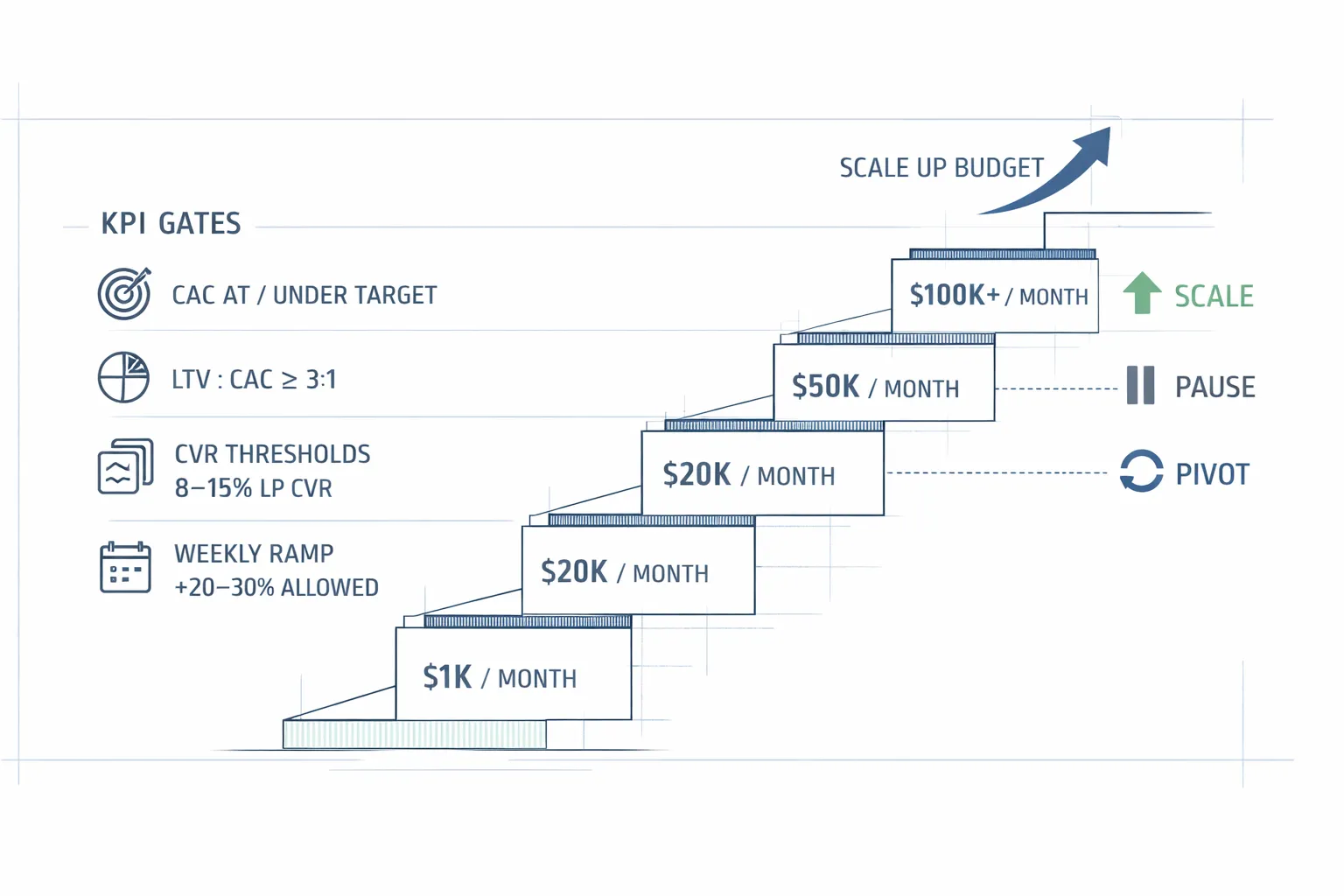
Paid ads scale safely when budgets follow profit, not vanity metrics. Use this profit-first model to move from your first $1k to $100k+/month without breaking unit economics.
The profit-first allocation model
- Split budgets into Learn (20 to 40%) vs Earn (60 to 80%).
- Learn = experiments across audience, creative, offers, and bids (fast readouts).
- Earn = proven campaigns that hit CAC or LTV:CAC targets.
- Prioritize demand capture first (brand and high-intent search). Layer in demand creation with clear KPI bridges to pipeline/revenue (view-through, assisted conversions, SQL influence). This approach keeps paid advertising durable through rising CPCs.
Spend tiers, KPI gates, and ramp logic
- $1k to $5k/month: tight intent keywords, 1 to 2 evergreen creatives, 1 high-value offer (demo/trial/flagship asset).
- $5k to $20k/month: expand match types and audiences; introduce second channel; 3 to 6 creatives; enforce KPI gates.
- $20k to $50k/month: multi-offer testing, mid/BOF remarketing tiers, frequency caps to slow fatigue.
- $50k to $100k+/month: multi-country, PMAX/ASC cautiously with strong guardrails; run incrementality tests (geo-holdout/PSA).
Bidding strategies by stage
- Search (Google/Bing)
- Start: Maximize Conversions with target CPA guidance (portfolio bid strategy) once initial conversions are accruing.
- Graduate: tCPA or tROAS after 30 to 50 recent conversions per campaign/ad group; keep query maps clean (exact/phrase SKAG-lite).
- Social (LinkedIn/Meta/TikTok/YouTube)
- Start: Lowest cost with cost caps where available; optimize to the strongest downstream signal (lead quality, qualified traffic).
- Scale: Introduce bid caps when you need volume and cost control; separate prospecting vs retargeting budgets to prevent auction cannibalization.
Pacing and cashflow protection
- Budget velocity: limit week-over-week changes to +/- 20 to 30% to protect learning phases and algorithm stability.
- Two-win rule before material scaling: two separate wins (e.g., two creatives or two ad groups below CAC target with stable volume) before ramping > 20%.
- Daily/weekly guardrails:
- Daily: pause/rotate if CAC > target by 25% for 3+ consecutive days after minimum spend thresholds.
- Weekly: scale if CAC <= target and LP CVR is stable or improving; otherwise prioritize CRO or new creative before adding spend.
Platform split guidance (SaaS/B2B tilt)
- Start: Google 60 to 70%, LinkedIn 10 to 20%, Meta 10 to 20%, TikTok 0 to 10% (as fit).
- Grow: Shift 10 to 20% into Meta/TikTok for affordable reach and creative learning; protect branded search impression share (>= 80 to 90%).
Budget ramp plan by tier
| Spend Tier (Monthly) | Channel Split (Google / LinkedIn / Meta / TikTok) | Test vs Scale (Learn / Earn) | Expected CTR (Search / Social) | Expected LP CVR | CAC Expectation | Decision Thresholds (Scale / Pause / Pivot) | | --- | --- | --- | --- | --- | --- | --- | | $1k | 70% / 15% / 15% / 0% | 40% / 60% | 6 to 10% / 0.8 to 1.2% | 5 to 8% | <= Target +10 to 15% | Scale: 2 creatives or 1 ad group within target for 7 days; Pause: CAC > target +25% after min 100 clicks or $250 spend/variant; Pivot: LP CVR < 5% -> prioritize CRO/offer. | | $5k | 65% / 15% / 15% / 5% | 30% / 70% | 5 to 9% / 0.8 to 1.5% | 6 to 10% | <= Target +10% | Scale: weekly +20 to 30% if CAC and CVR stable; Pause: 3-day CAC spike > 25%; Pivot: expand match types/audiences, add 2 to 3 new hooks. | | $20k | 60% / 20% / 15% / 5% | 25% / 75% | 5 to 8% / 0.9 to 1.6% | 8 to 12% | <= Target | Scale: elevate budgets and introduce retargeting tiers; Pause: frequency > 3 and CTR falling 20% WoW; Pivot: ship new offer/LP variant, add video formats. | | $50k | 55% / 20% / 20% / 5% | 25% / 75% | 4 to 7% / 1.0 to 1.8% | 8 to 14% | <= Target | Scale: step-ups of 20 to 30% with audience expansion; Pause: rising CPC + falling CVR; Pivot: channel-native creative, refine BOF remarketing windows. | | $100k+ | 50% / 20% / 20% / 10% | 20% / 80% | 4 to 7% / 1.0 to 2.0% | 9 to 15% | <= Target (Stable Payback) | Scale: multi-country, cautious PMAX/ASC with exclusions; Pause: CAC drift > 15% for 2 weeks; Pivot: run geo-holdouts/PSA tests, diversify offers and countries. |
Notes on the table:
- Expected CTR and LP CVR are directional targets to guide paid campaigns; set precise thresholds by vertical and historicals.
- CAC expectations anchor to your target; early tolerance narrows as volume grows and LTV:CAC clarity improves.
How Gabriel Zamp ramps your paid advert program:
- We start with demand capture and a tight Earn core, then use Learn budgets to pressure-test hooks, formats, and offers.
- As ads paid volume grows, we safeguard cashflow with pacing rules, bid strategies, and cohort-based LTV:CAC so you scale paid for advertising only when unit economics are solid.
Measurement That Protects Unit Economics (GA4, GTM, Server-Side, Offline Conversions)
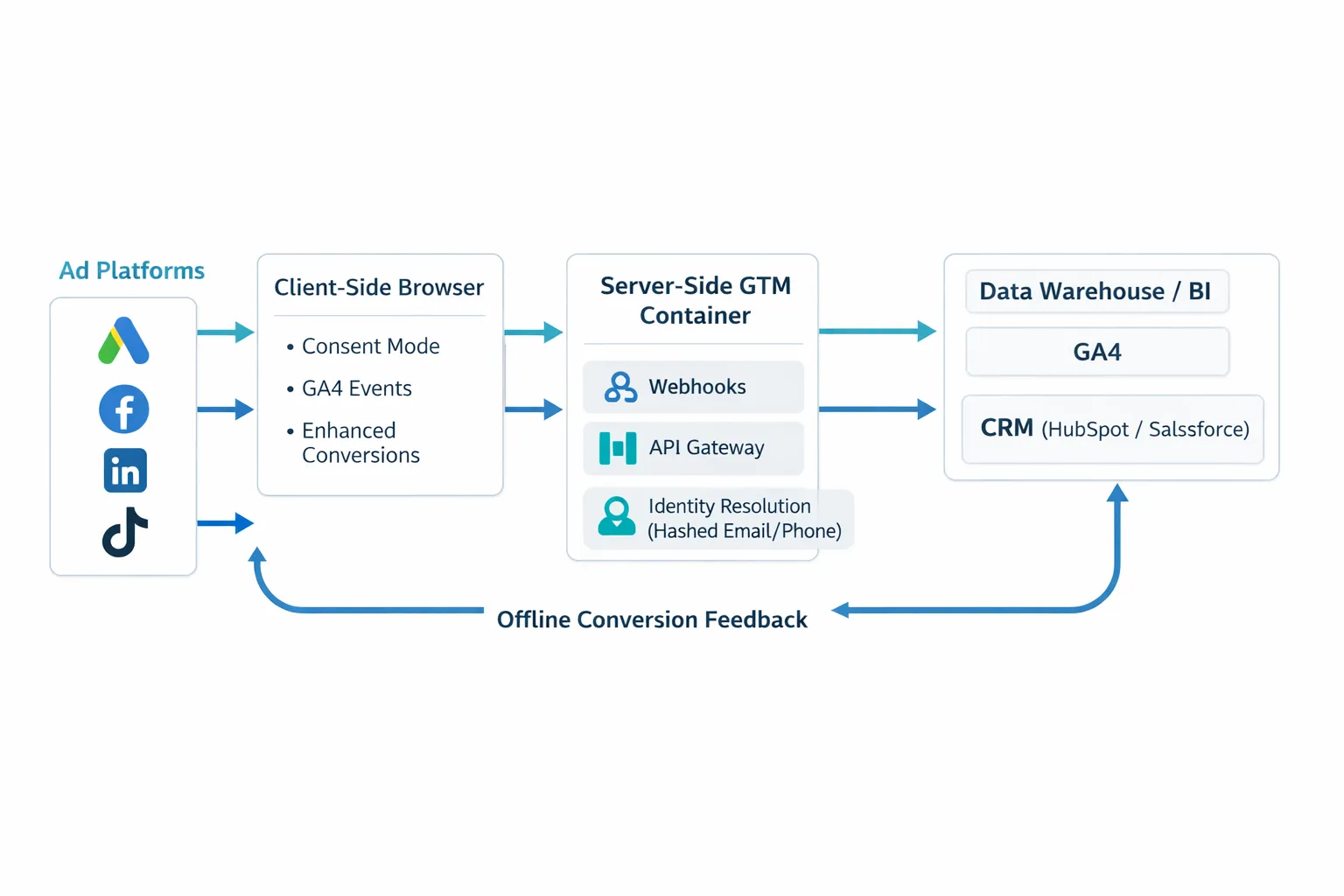
Great creative without trustworthy measurement is just expensive noise. To scale paid ads while protecting CAC and LTV:CAC, your data layer must be precise, privacy-safe, and connected to revenue - not just clicks.
Tracking foundations and signal integrity
- GA4 event schema, consent mode, enhanced conversions
- Standardize events (view_item -> add_to_cart -> generate_lead -> purchase/submit_lead) with clear parameters (source, medium, campaign, content, creative_id, offer).
- Enable Consent Mode v2 and Enhanced Conversions to preserve model-led coverage when user consent is limited.
- Server-side tagging to mitigate browser/iOS signal loss
- Route key events through server-side GTM to improve match rates, reduce ad blocker loss, and control data governance (PII hashing, IP anonymization, region routing).
CRM + offline conversions
- Pipe qualified lead and revenue milestones back to Google/Meta/LinkedIn
- Sync MQL, SQL, Opportunity, Pipeline $, Closed-Won, and Churn events to ad platforms via offline conversions (GCLID/GBRAID/WBRAID/Click IDs + hashed emails).
- Map primary outcome to optimize for quality
- Choose one primary optimization event per campaign that best correlates to revenue (e.g., SQL or Pipeline Created), then use secondary events for learning and diagnostics.
Attribution for decision-making
- Use blended reporting: channel attributions + cohort LTV
- Pair platform-reported conversions with GA4/DDAs and CRM revenue by cohort. Optimize spend using payback windows and LTV:CAC, not last-click alone.
- Embrace modeled conversions and convert-lift tests for top-of-funnel
- Run geo-holdouts, PSA or ghost-ad tests, and use modeled conversions to credit demand creation where deterministic tracking is thin.
UTM governance and data hygiene
- UTM standards and dynamic parameters
- Enforce utm_source, utm_medium, utm_campaign, utm_content, utm_term conventions with dynamic macros (keyword, placement, ad_id, creative) to enable cross-team clarity.
- Campaign naming conventions
- Include objective, audience, funnel stage, offer, region, and sprint date. Automate checks to catch gaps and malformed UTMs.
Readout cadence
- Daily QA alerts
- Monitor tag fires, event volume anomalies, match rate, CPC/CVR shifts, and budget pacing; auto-alert with thresholds.
- Weekly KPI review
- Channel-level CAC, CVR, CTR, CPM, frequency, creative fatigue; decisions on scale/pause/pivot.
- Monthly cohort/LTV
- D7/D30/D60 payback, LTV:CAC by segment, offer, and channel; attribution triangulation (platform vs GA4 vs CRM).
- Quarterly MMM/MTA hybrid checks
- Lightweight MMM or contribution analysis reconciled with MTA for long-term calibration; use findings to rebalance demand creation vs capture.
How Gabriel Zamp implements this stack:
- We deploy GA4 + server-side GTM, wire offline conversions to your CRM, and standardize UTMs and naming so every dollar in paid advertising maps to pipeline, payback, and profit.
Creative That Converts: Frameworks, Angles, and Testing Cadence
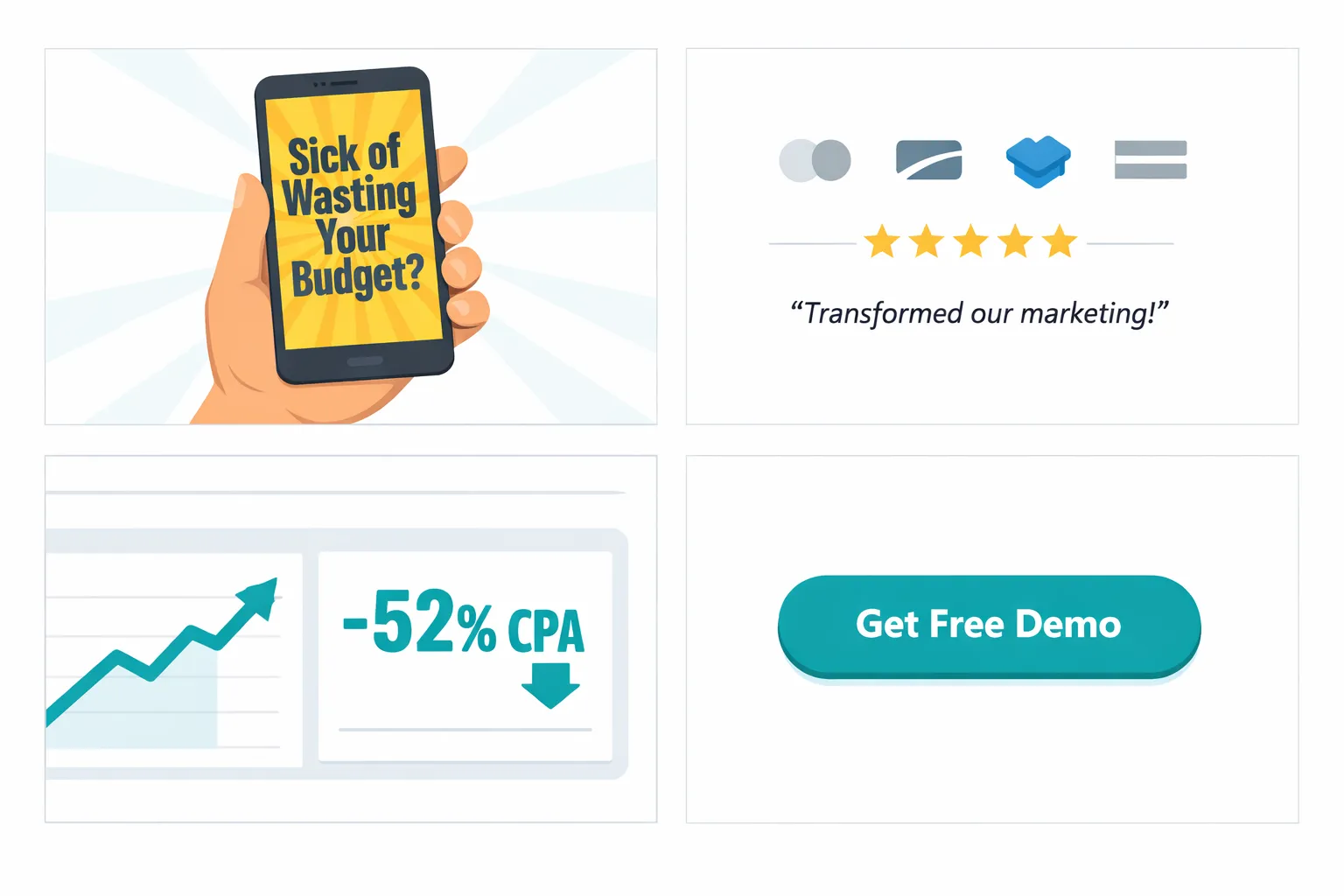
Great creative reduces your effective CPC, lifts CVR, and protects CAC - especially as auctions tighten. Here is how we operationalize creative so it consistently drives pipeline, not just clicks.
The creative operating system
- Message-market match via jobs-to-be-done and objection mapping
- Identify the job your buyer is hiring you to do, then map primary objections (budget, risk, time-to-value). Each concept addresses one job and one objection.
- 3-part ad structure: Hook -> Proof -> Offer/Next Step
- Hook: problem pattern interrupt ("Your CAC is rising because your LP is leaking.")
- Proof: social proof, third-party stat, or product moment (e.g., "52% CPA reduction in 30 days").
- Offer/Next Step: demo, calculator, scorecard, or 7-day trial.
Angles and formats by platform
- Google: RSAs with keyword + pain + proof assets; site links to offers; image extensions.
- YouTube: in-feed or Shorts with 1-sec pattern interrupt, problem setup, proof, CTA end cards.
- Meta/TikTok: UGC and founder-led talking heads, split-screen product moments, subtitles.
- LinkedIn: Document ads (carousel playbooks), thought leadership clips, stat cards with CTA.
Testing cadence
- Weekly: 2 to 4 hooks, 2 proofs, 1 CTA variant; rotate losers fast (kill at 1.5x CAC target or CTR < benchmark after min spend).
- Refresh cadence: 20 to 30% of spend on new concepts weekly to reduce fatigue; clone winners with new hooks/first 3 seconds.
Offers that improve unit economics
- Lead magnets (benchmarks, templates), ROI calculators, scorecards/assessments, mini-demos, and time-bound incentives that compress payback and qualify demand.
Governance and creative QA
- Brand/claims checks, legal/compliance for regulated niches, accessibility (contrast, captions, readable typography), and platform-native aspect ratios. Use consistent naming for version control and learning transfer.
Creative Testing Matrix
| Hook (Problem/Outcome) | Angle (Proof/Story) | Offer | Tests/Week | Sample Hypothesis | Success Metrics | | --- | --- | --- | --- | --- | --- | | Your CAC is rising because your LP leaks | Case study: 52% CPA reduction in 30 days | Mini-demo | 4 | Social proof + product moment will increase CTR and CVR vs generic claims | CTR >= 1.5% (social), Thumbstop >= 25%, CPC down 15%, LP CVR >= 10%, CAC <= target | | Cut your sales cycle by 21 days | Founder talk + objection bust (No devs needed) | ROI calculator | 3 | Founder-led explainer reduces friction, improving qualified clicks | CTR >= 1.2%, 3s view >= 35%, CPC down 10%, Calculator start rate >= 20%, SQL rate up | | Your brand terms are being hijacked | Competitive SERP screenshot motif | Audit/Scorecard | 3 | Urgency + audit CTA drives BOF conversions at lower CAC | Search CTR >= 7%, CVR >= 12%, CAC <= target, SQL rate >= benchmark | | Stop wasting 40% of paid spend | Third-party stat + quick LP teardown | Free teardown | 2 | Educational proof increases Thumbstop and assisted conversions | Thumbstop >= 30%, Assisted conv up, View-through pipeline up, CVR >= 9% | | From $1k to $100k/month without breaking CAC | 12-week roadmap highlights | Strategy session | 2 | Roadmap offer increases high-intent bookings | CTR >= 1.3%, CPC down, Form completion >= 25%, SQO rate >= benchmark |
How we make creative your growth lever:
- We ship multiple hooks weekly, enforce clear kill rules, and scale only the variants that move CAC, CVR, and pipeline. Offers act as conversion multipliers, and every learning feeds the next sprint so your creative portfolio compounds.
Channel Playbooks That Still Work in 2026 (Google, Meta, LinkedIn, TikTok)
"95% of B2B buyers are out-of-market at any given time." - Source
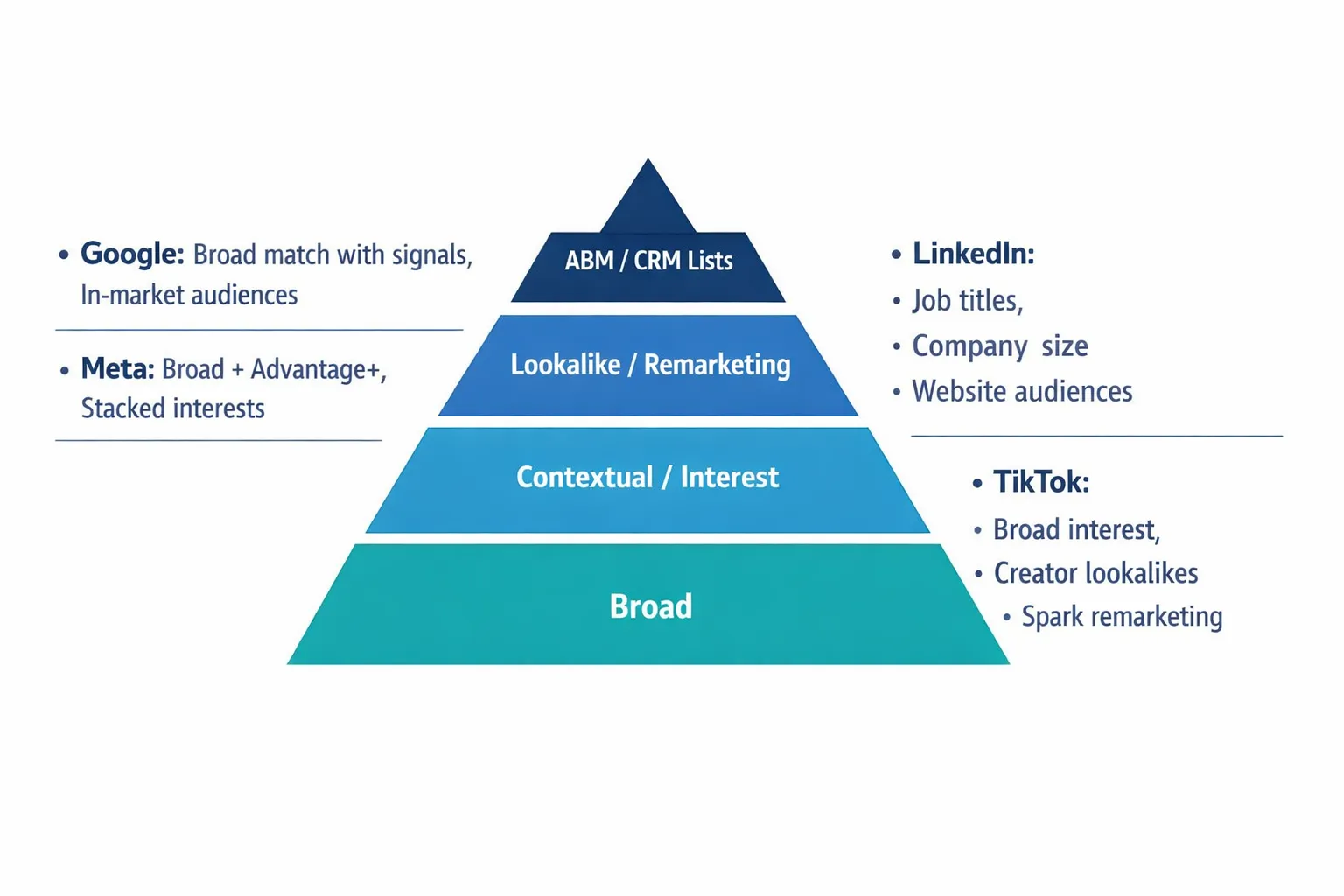
Google Ads
- Demand capture first: own brand terms (>= 80 to 90% IS) and high-intent non-brand with tight negatives; handle competitor nuance with compliant copy and smart bidding.
- PMAX cautiously for SaaS: use asset groups with clear audience and URL signals; exclude brand where possible; for ecommerce, prioritize feed quality (titles, attributes, and merchant center health) to lift PMAX performance.
- Structure for control: SKAG-lite (exact/phrase core), query mapping, budgets separated by funnel stage; adopt tCPA/tROAS once you have 30 to 50 recent conversions.
Meta Ads
- Advantage+ (ASC) and stacked interests: let the algorithm hunt broadly while you drive outcomes with creative-market fit; separate prospecting vs retargeting budgets.
- Creative-first scaling: iterate hooks weekly, monitor frequency (ideal 1.5 to 3.0 at prospecting); suppress recent converters and high-frequency users to slow fatigue.
- Use cost/bid caps when scaling to protect CAC and maintain volume predictability.
LinkedIn Ads
- Document Ads for MoFu education (playbooks, benchmarks); Conversation Ads for ABM personalization into decision-makers.
- Targeting: website audiences layered with job titles, skills, and company size for precision; use audience expansion deliberately for reach.
- Lead Gen vs Website Conversions: Lead Gen forms drive volume; Website conversions often yield higher quality and better downstream SQL rates - test both and optimize to offline quality.
TikTok Ads
- Hook density and UGC authenticity: fast-cut edits, native text overlays, lo-fi production, and creator collaboration to drive thumb-stop and qualified traffic.
- Spark Ads with creators: leverage creator handles for social proof and comments; remix top performers for LinkedIn Shorts/Meta Reels.
- Use TikTok for affordable reach to seed retargeting pools and discover winning hooks before cloning to other channels.
Cross-channel orchestration
- Sequenced journeys: Awareness (UGC/Doc Ads/YouTube Shorts) -> Education (case studies, calculators, teardown videos) -> Conversion (search/retargeting) -> Expansion (upsell/cross-sell).
- Budget shifts: Move 10 to 20% weekly toward channels/ad sets where CPMs and CPCs are favorable and creatives are fresh; pull back where frequency rises and CTR falls.
- Common rules: refresh 20 to 30% of creative monthly, protect brand search, and use offline conversions to fund the channels that create pipeline - not just clicks.
How we run these playbooks at Gabriel Zamp: we blend demand creation and capture, keep creative velocity high, and reallocate budgets dynamically - so you compound LTV:CAC and scale with confidence across Google, Meta, LinkedIn, and TikTok.
Offers and Landing Pages That Print Pipeline (CRO for Ads Paid Traffic)
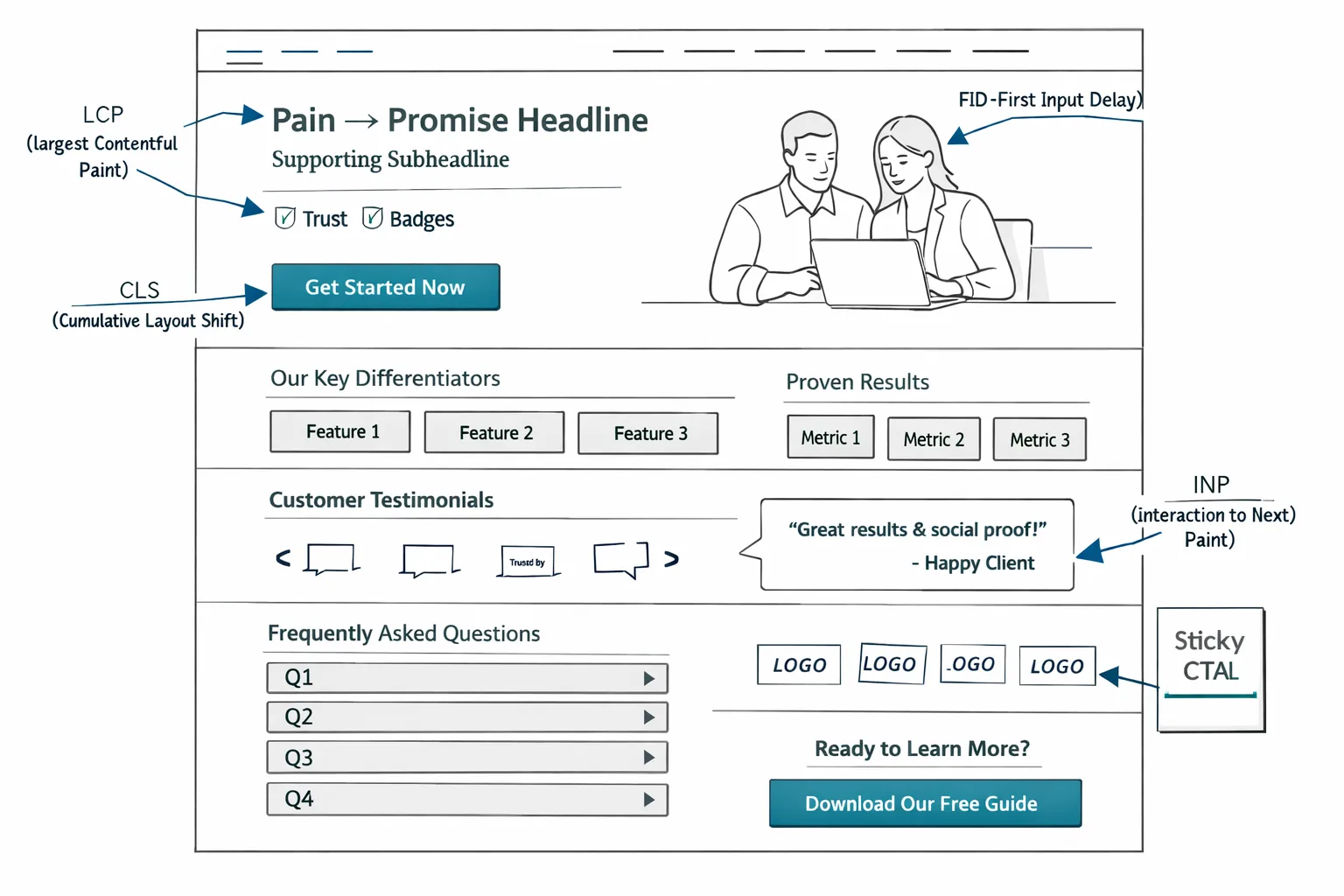
Great ads paid performance collapses without conversion discipline. Your offer and landing page should accelerate time-to-value, qualify demand, and make it effortless to take the next step.
High-converting offer patterns
- Friction-appropriate CTAs: demo for BOF, audit/teardown for MoFu, interactive tools (calculators, scorecards) for awareness; free trials where activation is guided.
- Value ladders: move from lead magnets -> assessment -> mini-demo -> strategy call -> paid pilot -> expansion.
Landing page structure
- Above the fold: pain -> promise -> proof -> primary CTA
- Headline names the pain and desired outcome; subhead clarifies the promise; trust badges/testimonial; one dominant CTA.
- Mid-page: differentiators, objection handling, FAQs, soft CTA
- Visualize how you are different (speed to value, integrations, pricing clarity). Add FAQs to preempt legal/security/procurement friction and a lower-commitment CTA.
Speed, clarity, and proof
- Speed budgets: target Core Web Vitals (LCP <= 2.5s, CLS <= 0.1, INP <= 200ms). Lazy-load below-the-fold assets and optimize images.
- Clarity > cleverness: concise copy, scannable bullets, quantified outcomes (e.g., -32% CAC in 6 weeks), and specific social proof (logos, video testimonials, case stats).
"A 0.1-second improvement in mobile site speed drove an 8.4% lift in retail conversions (and 10.1% in travel)." - Source
Experimentation
- A/B tests: headline hierarchy, hero creative, form length (progressive profiling), value props, risk reversal (SLA, guarantee), and social proof placement.
- Multi-armed bandit: at higher volumes, allocate traffic dynamically to winning variants to minimize regret and accelerate learning.
Activation and handoffs
- Thank-you page upsells: route to a relevant next step (calendar booking, onboarding micro-video, product tour).
- Lifecycle drips: email/SMS sequences tied to offer intent; re-engagement for abandons.
- SDR SLAs: < 5-minute response on hot leads increases qualification and close rates; use round-robin + alerts to enforce.
How Gabriel Zamp turns ads paid clicks into pipeline:
- We align friction-appropriate offers to each funnel stage, ship wireframes that prioritize speed and proof, and run disciplined CRO sprints so your paid advertising dollars translate into SQLs, pipeline, and predictable payback.
Scaling With Discipline: Bids, Frequency, Incrementality, and Burnout Prevention
Scaling paid ads is a systems game. You protect CAC and payback by evolving bid strategies, managing frequency, proving incrementality, and enforcing cohort guardrails - while keeping both your audiences and your team out of burnout.
Bid strategy evolution
- Start wide, then add control
- Meta/TikTok: begin on Lowest Cost (maximize delivery). Add cost/bid caps only once you see stable volume and need price discipline. Separate prospecting vs retargeting budgets to avoid cannibalization.
- Google: start with Maximize Conversions (with a guidance CPA). Move to tCPA or tROAS after ~30 to 50 recent conversions per campaign. Use portfolio strategies and query mapping (exact/phrase core; negatives maintained weekly).
- LinkedIn: begin with Maximum Delivery for scale; test manual CPC where CPC volatility is high. Shift to Website Conversions or Lead Gen optimized to the highest-quality offline signal available.
- Change velocity rules
- Budget steps of +/- 20 to 30% week over week; avoid frequent, large same-day edits that reset learning.
- Adjust targets gradually: tCPA/tROAS changes in 10 to 15% increments; allow 3 to 5 days to stabilize before re-evaluating.
Frequency and fatigue management
- Healthy frequency bands (prospecting)
- Meta/TikTok: 1.5 to 3.0 per 7 days. If frequency > 3.5 and CTR drops > 20% WoW, rotate creatives and expand audiences.
- LinkedIn: 2 to 5 per 30 days. Cap job-title retargeting to avoid ad blindness in niche segments.
- YouTube: weekly frequency ~1.2 to 2.0 for in-feed/Shorts; manage via inventory expansion and creative rotation.
- Rotation and exclusions
- Rotate 20 to 30% of spend to new concepts weekly; retire any unit hitting 1.3x CAC target after minimum effective spend or CTR below benchmark for 3+ days.
- Suppress converters (7/30/90-day windows by offer) and high-frequency users; use dayparting for B2B (throttle nights/weekends if CVR materially falls), while keeping high-intent search largely always-on.
- Burnout prevention (audience and team)
- Maintain a creative backlog and templates to ship weekly without heroics; repurpose winners cross-channel with native tweaks.
- Limit platform edits to scheduled windows; publish change logs so analysis is not polluted by constant resets.
Measuring incrementality
- Causal designs
- Geo-split/matched markets: randomize cells, define Minimal Detectable Effect (MDE), and run 4 to 6 week tests for mid/upper funnel.
- PSA/ghost-ad tests: holdout exposure to estimate lift where platform lift studies are not available.
- Platform lift studies: Meta Conversion Lift, YouTube/Google Brand Lift; use to calibrate your blended model, not to fully replace it.
- Practical guidance
- Test one big lever at a time (new channel, new offer, heavy retargeting). Document hypotheses, traffic allocation, and stopping rules pre-test.
- Use modeled conversions where consent is limited; reconcile platform, GA4/DDA, and CRM cohort revenue in weekly readouts.
LTV:CAC and cohort guardrails
- Define break-even curves
- Track D7/D30/D60 payback and cohort LTV by channel, offer, and audience. For B2B, require pipeline creation by D30 and payback within 90 to 180 days unless strategic exceptions are approved.
- Scaling thresholds
- Scale if: CAC <= target (or LTV:CAC >= goal) for 2 consecutive weeks with stable volume and no rising fatigue signals.
- Hold/pivot if: CAC is within 10 to 15% over target but CVR is improving (prioritize CRO/offer lift before adding budget).
- Pause if: CAC > target by 25%+ for a full week with deteriorating trends after minimum spend and fresh creative.
When to add or exit a channel
- Add a channel when
- You have achieved >= 80 to 90% impression share on brand and efficient non-brand, and marginal CPCs are rising (capture is saturated).
- You have 2 to 3 proven creative concepts that can be adapted natively, plus tracking and offline conversions in place.
- CPMs are favorable and early tests show promising thumb-stop/CTR and quality traffic.
- Exit or reduce when
- Sustained CPM/CPC inflation (e.g., > 30 to 40% QoQ) and creative refreshes fail to restore CTR/CVR.
- CAC remains > 1.25x target across two test sprints despite offer/CRO changes.
- Audience saturation: frequency keeps rising while reach stalls and assisted conversions decline. Keep a light retargeting layer; redeploy prospecting to higher-yield channels.
How we scale with discipline at Gabriel Zamp:
- We graduate bids as signal density improves, enforce frequency and rotation guardrails, prove causality with lift tests, and fund what wins on LTV:CAC by cohort. That is how you grow from efficient to dominant - without torching margin or your team.
Operating System: Weekly Rituals, Dashboards, and Decision Trees
A disciplined operating system turns paid ads from guesswork into compounding ROI. Here is how we run weekly rhythms, report transparently, and make fast, high-quality decisions that protect unit economics.
Weekly execution rhythm
- Monday
- Standup: goals, guardrails (CAC, LTV:CAC, payback), risks.
- Hypothesis backlog review: prioritize by ICE/PIE; finalize sprint scope.
- Approvals: creative/storyboards, copy, offers, LP changes.
- Tuesday
- Launches: campaigns/ad sets/ad groups; QA tracking (GA4, GTM server-side, pixels).
- Baseline logging: sample-size targets, cost ceilings, expected lift.
- Wednesday
- Early readouts: CTR, CPC/CPM, LP CVR, quality checks (MQL -> SQL).
- Midweek course-corrections: rotate low CTR creatives, fix query maps, CRO hotfixes.
- Thursday
- Expansion: new hooks/angles, audience splits, offer variants; adjust pacing.
- Documentation: change log, experiment tracker updates, learnings.
- Friday
- Weekly readout: performance vs guardrails; scale/pause/pivot calls.
- Backlog grooming: archive completed tests; prep next sprint assets.
Reporting and transparency
- One-page weekly dashboard
- Spend, CPM, CPC, CTR, LP CVR, CAC/CPA, ROAS, brand IS, frequency.
- Pipeline view: MQL -> SQL -> Opp -> Revenue, payback (D7/D30/D60), LTV cohorts by channel/offer.
- Executive summary
- Highlights/lowlights, root causes, incremental impact, next experiments.
- Risks/asks: creative gaps, CRO priorities, tracking issues, budget shifts.
Decision trees and playbooks
- If CAC rises > 20% WoW
- Isolate variables: CPC/auction intensity -> creative CTR -> LP CVR -> sales cycle drift.
- Actions: add negatives/tighten queries; rotate top 2 new hooks; fix LP friction (above-the-fold, form fields); daypart if B2B off-hours underperform; recheck offline conversion mapping.
- If volume falls but CAC stable
- Actions: expand audiences/match types; raise budgets +20 to 30% where efficient; test new offers (calculator/scorecard/trial); remove pacing caps/limits; broaden geo where fit.
- If frequency > 3.5 (prospecting) and CTR down > 20% WoW
- Actions: refresh creative (new openers), widen audiences, reduce retargeting pressure, adjust bid caps, sequence ads (education -> proof -> offer).
- If tracking anomalies
- Actions: roll back last changes; verify client-side vs server-side parity; event QA; confirm consent/enhanced conversions; restore backups.
Cross-functional alignment
- Sales loop
- Weekly feedback on lead quality, top objections, stage velocity, and lost reasons. Share call snippets to inform hooks and LP copy.
- Product insights
- Roadmap changes, pricing tests, competitive intel, onboarding friction - all feed messaging and offer design.
- Lifecycle integration
- Nurture sequences aligned to offers and funnel stage; retargeting sync with email/SMS cadences; SLAs for < 5-minute hot-lead responses.
Documentation and compounding learnings
- Sprint retros
- What shipped, what moved CAC/CVR, what to stop doing. Capture insights as reusable playbook cards.
- Testing repository
- Hypothesis, KPI, sample size/power, audience/offer/creative IDs, decision and rationale, links to assets/LPs.
- Creative vault
- Versioned hooks, scripts, thumbnails, captions, top performers by platform and audience.
- Platform notes
- Bid strategy changes, exclusions, negatives, frequency caps, pacing edits, and their impact.
Templates (make a copy to use)
- One-page KPI dashboard (Looker Studio): https://portermetrics.com/en/templates/google-looker-studio/free-metrics-tracking/?utm_source=openai
- Experiment tracker (Google Sheets): https://docs.google.com/spreadsheets/d/1XUfLJcSZnXe1ny0d98quPEd3XyLaXGyZtekb3dCBqhc?utm_source=openai
Conclusion - Start Winning With the G.R.O.W.S Method
Why this works
A disciplined, experimentation-led approach that aligns ads paid efforts to revenue, not vanity metrics. You get faster learning loops, clearer attribution, and profit-first scaling guided by LTV:CAC and cohort payback - so every dollar compounds.
The brands that win in 2026 will test faster, measure better, and scale what actually prints profit.